

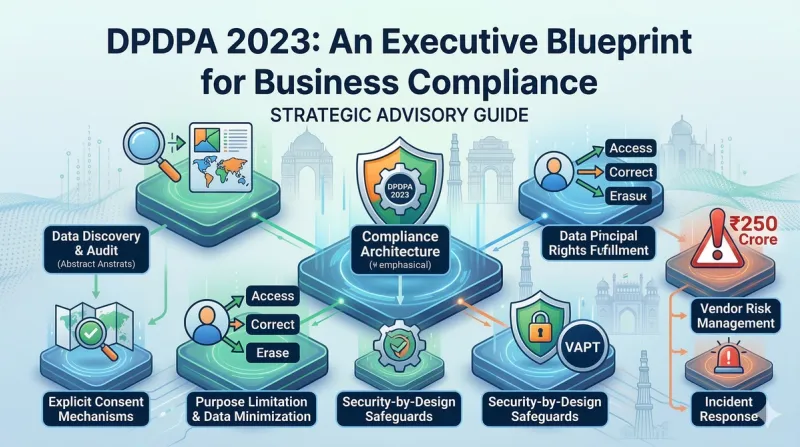
The digital landscape in India has just undergone its most significant evolution to date. If your business handles the personal data of customers names, phone numbers, emails, biometric details, or even browsing history, the Digital Personal Data Protection Act, 2023 (DPDPA) is no longer optional. It is the mandatory operational rulebook.
This expanded guide provides an actionable framework to shift your business from "data-unaware" to "privacy-by-design."
Part 1: Establishing the Foundation (Who and What)
Compliance begins with absolute clarity. The Act creates three primary roles, and you must understand exactly where your business and your partners fit.
1. The Cast of Characters: Real-World Scenarios
Let's translate these legal terms into real-world operations. To illustrate, we will look at 'Flex Gyms,' a hypothetical fitness chain, and examine how the DPDPA applies to their member data and third-party vendors.
| Role (Defined by DPDPA | Your Real-World Example | Description & Key Responsibility |
|---|---|---|
| Data Principal | The App User, the Gym Member, the Newsletter Subscriber | The individual (not another business) whose data you hold. They are the true owners of their data and hold the rights defined by the law. |
| Data Fiduciary | Your Business (e.g., Alpha E-commerce, Flex Gyms, Beta SaaS) | You are the entity that decides why and how the personal data is collected and used. You bear the ultimate legal responsibility for the data. |
| Data Processor | Your Vendor (e.g., Cloud Storage Provider, Payment Gateway, SMS Notification Service) | A third party that processes data only on the instructions of the Data Fiduciary. They do not decide 'why' but execute 'how.' The Fiduciary must audit them. |
2. What Data is Actually Covered?
The Act applies to "personal data" in digital form, or data collected non-digitally and then digitized. This includes:
- Identifiable Information: Name, email, phone number, address, Aadhaar number.
- Sensitive Data (implied higher standard): Though not explicitly separated into classes, the standard for 'Reasonable Security Safeguards' is higher for financial data, biometric info, health data, sexual orientation, genetic data, and precise geolocation.
- Behavioral Data: Browsing patterns and user interaction on an app, if that data can link back to an identifiable individual.
Part 2: The Core Operational Duties: Your Compliance Framework
To comply, your business must adopt new behavioral norms. Think of these as the fundamental habits of a privacy-conscious organization.
1. The Right Foundation: Lawful Basis for Processing
You cannot collect personal data 'just because.' You must have one of several defined lawful grounds.
A. Consent (The Golden Standard)
In most cases, you will process data because the customer agreed. The DPDPA dictates that this consent must be a clear, unambiguous, affirmative action.
- The 'No-No': Pre-ticked checkboxes or burying consent within complex Terms and Conditions.
- The 'Yes-Yes': Granular (itemized) opt-ins where a user explicitly clicks "Yes" to "receive newsletters" and separately "Yes" to "share data with third-party partners."
B. Other Grounds (Legitimate Uses)
- To fulfill a contract: Collecting an address to deliver a purchase.
- For legally mandated reasons: Retaining transaction data for tax filings.
- In a medical emergency: When a user cannot give consent.
2. The Implementation Habit: 'Notice at the Point of Collection'
Consent means nothing without information. You must give the user a simple Notice before or at the same time you collect data. This notice must clearly state:
- Exactly what personal data is being collected.
- The precise purpose of the collection (e.g., "to authenticate your account" rather than "for improved service").
- How the user can exercise their rights.
3. The New Mindset: Data Minimization and Purpose Limitation
This is the most critical shift in strategy. You may only collect the minimum necessary data to achieve the stated purpose.
- Old Way: An app requires camera and contact access just for a basic account profile.
- DPDPA Way: If you are a calculator app, you do not need contact access. Collecting unnecessary data is a direct violation.
Furthermore, once the purpose is fulfilled (e.g., the delivery is complete or the user closes their account), you must either erase the data or anonymize it.
4. Technical and Technical/Organizational Safeguards
You are legally bound to protect the data you hold. The Act mandates "Reasonable Security Safeguards" to prevent personal data breaches. It does not list specific tech, but implies:
- Data Minimization (Reduces Risk): Not having the data is the best security.
- Technical Controls: Encryption (at rest and in transit), robust access management (Multi-Factor Authentication), and regular VAPT (Vulnerability Assessment and Penetration Testing).
- Organizational Controls: Employee training and data protection policies.
Part 3: Mastering User Rights (Data Principal Rights)
The DPDPA empowers the citizen, giving them true control over their digital identities. As a Data Fiduciary, you must create straightforward operational processes to fulfill these rights.
1. The Right Matrix: What Users Can Demand
| User Right (The Principle) | Your Operational Obligation (The Practical Implementation) |
|---|---|
| Right to Access & Information | Users can ask: "What data do you have on me, and who have you shared it with?" You must respond with a summary in a specified timeframe. |
| Right to Correction & Erasure | Users can demand that inaccurate data be corrected or outdated data be deleted ("The Right to be Forgotten"), unless retaining the data is legally required. |
| Right to Withdraw Consent | Users must be able to withdraw consent as easily as they gave it. (e.g., a simple toggle switch). |
| Right of Grievance Redressal | You must establish a simplified mechanism for users to raise complaints. You must appoint and publish the contact of a dedicated grievance officer. |
Part 4: Managing Third-Party and Cross-Border Risk
1. The 'Supply Chain Privacy' Audit
Your vendors (Data Processors) can break the law on your behalf. If their security fails, you pay the fine. You must:
- Audit all critical vendors to verify their security protocols.
- Update your vendor contracts to include mandatory DPDPA compliance clauses.
2. Transferring Data Across Borders
You are only permitted to transfer personal data outside of India to countries "notified" by the Central Government. You cannot transfer data to any country that the government has blacklisted or restricted. (The full white/blacklists are pending notification).
Part 5: The Stakes and Next Steps: Risk Mitigation
We cannot emphasize enough how seriously the DPDPA has set the penalties. They are explicitly designed to be significant and prohibitive.
| Nature of Non-Compliance | Maximum Penalty per Contravention |
|---|---|
| Failure to take reasonable security safeguards to prevent a data breach | Up to ₹250 Crore |
| Failure to notify the Board and affected Data Principals of a data breach | Up to ₹200 Crore |
| Failure to fulfill obligations concerning Data Principal Rights | Up to ₹150 Crore |
| General Non-compliance with other provisions | Up to ₹50 Crore |
Conclusion: Your Mandatory Compliance Checklist
If you take only four steps today, start here:
- Map Your Data: Conduct a complete audit to know what data you collect, why you have it, and where it lives.
- Audit Consent: Remove pre-ticked boxes and redesign your consent and notice forms immediately.
- Review Vendor Contracts: Validate that your critical processors (SaaS, cloud) are compliant.
- Appoint a Grievance Officer: Publish their contact information on your privacy policy page.
Navigating the complexities of the DPDPA doesn't have to stall your business operations. By taking a proactive approach to data privacy, you not only ensure legal compliance but also build a foundation of absolute trust with your customers. If you are unsure of where to start or need expert assistance implementing these frameworks, the team at StateCheck Security is here for you. Contact us today for hassle-free guidance and support to secure your digital future.